Case Study Video:
My Passengers: Marrissa Price (CW), Lorna Graham (AD)
*Young Ones ADC Merit Winner*
THE BRIEF
PROBLEM: Waymo is not the first pick amongst rideshare apps. INSIGHT: People fill what they don't know with fear. TARGET: Women who want to feel in control of their nights out. STRATEGY: Make Waymo women's refuge on the road.
THE SPARK
With the rise of AI tools, it was both refreshing and motivating to apply an AI product toward solving a real-world problem.
RESEARCH METHODS
1
Surveys
Quick polls revealed common patterns in safety concerns, routines, and trust issues especially around solo travel and late-night rides.
2
Bar Interviews
A night of bar interviews turned into real conversations, with everyone from friends out for drinks to teen soccer players and their parents from California, some of whom use Waymo.
3
Social Listening
Hours of TikTok scrolling showed how Waymo appears online (from safety stories to viral complaints) until my feed became nonstop Waymo ride videos.
4
Competitive Analysis
Compared Waymo to Uber and Lyft across trust, tech perception, and safety: revealing a clear gap in emotional connection and human-centered communication.
For every 1 Waymo rider...
Waymo
1 rider
Lyft/Uber
3 riders
Rideshare is a habit. Most people open Uber or Lyft on autopilot — they know what to expect, and that familiarity is hard to compete with.
THE CHALLENGE
Waymo isn’t the first pick for rideshare.
In a space ruled by human drivers, skepticism and misinformation about autonomous safety keep people from trusting the very technology built to protect them.
SOCIALS' VIEW ON WAYMO
Most negative reactions to Waymo come from misunderstanding, not experience.


INSIGHT
People fill what they don't know with fear.
When something is unfamiliar, people don’t leave it blank, they instinctively try to make it make sense. Without real information, their brain defaults to protective thinking, often imagining worst-case scenarios as a way to stay in control.
FOR WOMEN, SAFETY IS NEVER ASSUMED.
Uber Sexual Assault Report
2017-2022

AUDIENCE TRUTH
Women create their own safety systems because they all know firsthand what danger feels like.
It's not a secret that women aren't as safe as men in night life but, what isn't talked about is all the safety measures women go through so they don't get hurt or even killed
Safety Systems Women Use

These systems don't actually protect women.
Instead of expecting women to do more for the illusion of safety, Waymo can show it removes the problem entirely.
STRATEGY
Make Waymo women’s refuge on the road.
Waymo becomes a space women can trust when they feel most vulnerable; a reassuring alternative to traditional rideshares.

BAR ACTIVATIONS
It starts in the bathroom: where women feel safest, surrounded by other women. Waymo shows up with essentials and stall signage that play on the cultural moments women use in conversation, making safety part of it.
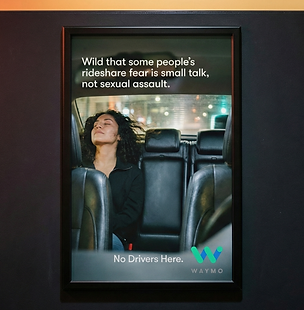


Waymo shows up in the moments that matter, with bar coasters that share key safety facts and prompt safer choices about getting home.

EXPERIENTIAL
Planned to launch during April’s Sexual Assault Awareness Month, the campaign partners with Take Back the Night: combining donations with a powerful Motorcade event that reclaims the streets and drives awareness.
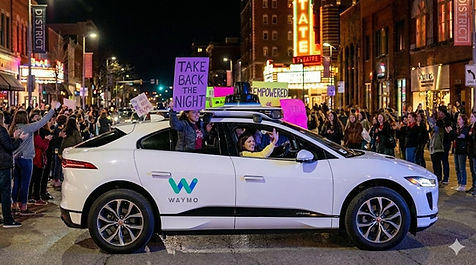

**Google Gemini was used to help generate these images.**
What I Learned
This project’s framing to solve a real issue showed me that advertising can have meaningful impact when approached with the right perspective.